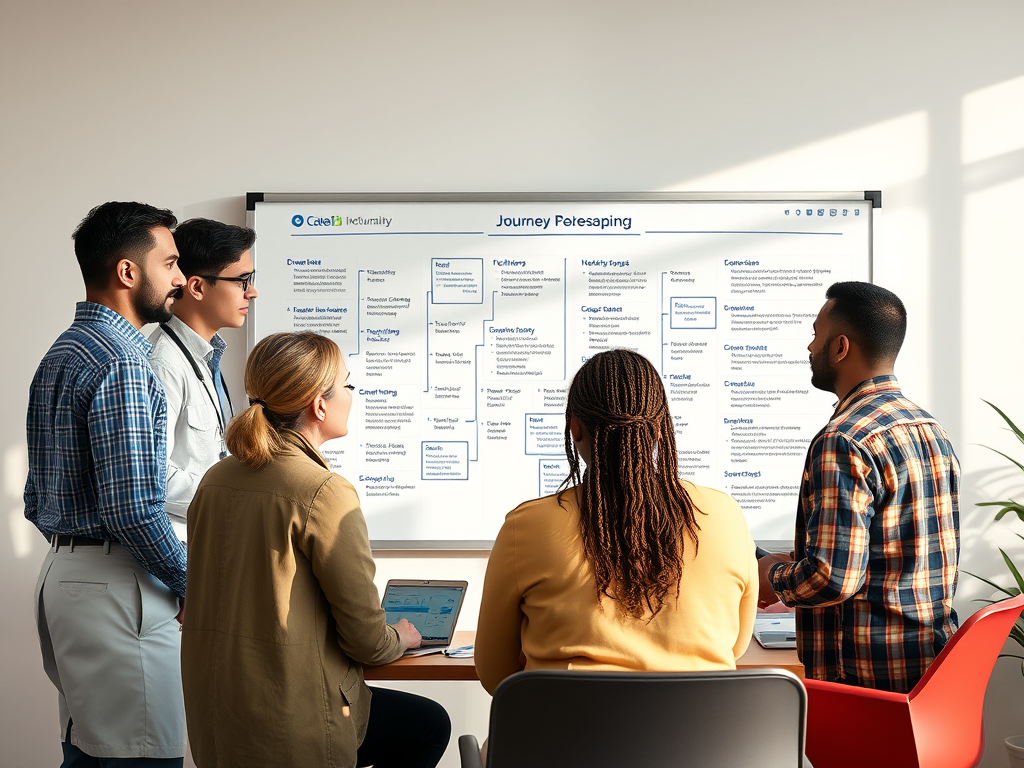
Journey Mapping is mostly seen as a tool that engages partners in the marketing or UX field but its applications can be applied in a variety of sectors. Recently, I had the opportunity to engage Spinal Cord Injury partners in a journey mapping exercise as we try to connect more veterans with Spinal Cord Injury to supported employment.
Supported employment helps connect veterans with career guidance, training, benefit counseling, and work place accommodation assistance. Often providers are looking to treat just the symptom or injury, working in silos, but veterans need a holistic approach to improve their physical, mental, and material well-being. Employment for veterans with Spinal Cord Injury can address all three needs. Despite its benefits, the program is still relatively unknown and underutilized. Utilizing a social marketing framework, we are creating videos for providers to learn more about the program and its benefits, but we still have some questions that needed answering.
During this exercise we asked the following questions as we guided participants through the exercise:
- Where do you meet or see Veterans with Spinal Cord Injury (SCI)? In these moments, do you talk to them about supported employment? How is this conversation for you?
- If a veteran with SCI is interested in employment, who do you do?
- Who are the key people you interact with when connecting a Veteran with SCI to employment services?
- What do you feel prevents Veterans with SCI getting access to supported employment? What would make it better?
- Where do you get information about a VA service such as employment services?
Before we began the exercise, we did a practice run to orientate the participants on how to use Microsoft Whiteboard. My go-to for any example is the now famous question, “What pet should I get?”. This always seems to be good way to help people relax into an unknown exercise and almost everyone always has an opinion on the matter! We allocated 5 minutes to the exercise but I highly recommend more for clinicians. Most people, including clinicians, are used to lectures and PowerPoint presentations, so any time you can give them to help wrap their brains around something different, that requires more creative thinking, is better.
We then moved on to the activity itself.

A few things I learned.
- We needed more time. This is very novel approach for clinicians. Compounded by the difficulty that most have never used this program. The more time you can give them, the better.
- We needed to walk through an example where the facilitator (me) was able to read through and probe for more specifics. Once I read out what a participant wrote, asked some questions, and got more information from them, others were better able to think through the steps of the exercise from their own perspective.
What are your own journey mapping lessons learned?
If you have done journey mapping in a clinical setting or with medical providers, I would love to hear from you!


Thank you for reading, and please feel free to reach out if you would like to learn more about how I can faciliate journey mapping for you.
Leave a Reply